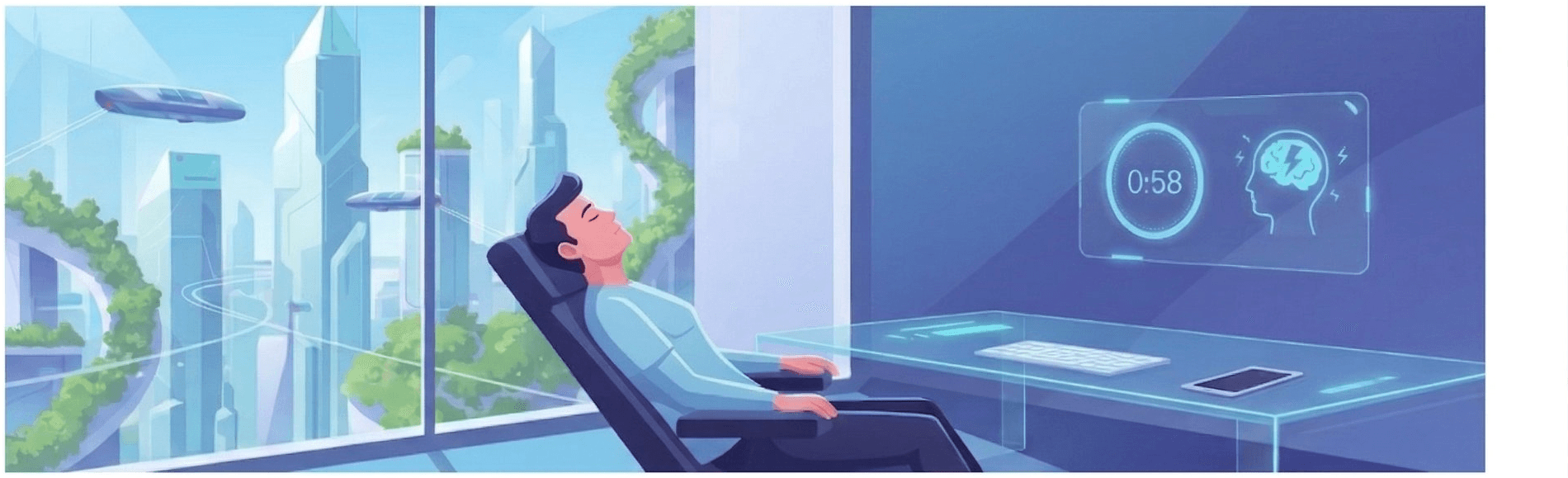
You're three hours into deep work. Your shoulders are creeping toward your ears. Your eyes feel like sandpaper. You reach for coffee instead of stepping away. That's the problem — and it's costing you more than you think.
Here's what the research actually says: your brain isn't designed for the eight-hour focus marathon we've normalized. It's designed for cycles of focused work followed by real recovery. And the good news? You don't need long breaks to reap the benefits. Five-minute interruptions, done strategically, can restore your attention, keep your eyes healthy, and actually make you more productive. Not someday. Today.
This isn't a nice-to-have. It's neuroscience.
Why Continuous Work Tanks Your Performance
Let's start with the uncomfortable truth: the longer you work without a break, the worse you get at your job.
Psychologists call this "attentional depletion," and it's well-documented. Your prefrontal cortex — the part of your brain responsible for focus, decision-making, and impulse control — is a finite resource. Like a muscle, it gets tired. And when it does, everything falls apart: you make careless mistakes, you make slower decisions, and you need more cognitive effort to do simple tasks.
One study at the University of Illinois measured how people perform on repetitive tasks over long periods. Researchers found that brief breaks prevented the significant performance decline that normally occurs, keeping accuracy levels stable instead of plummeting. The difference between quality work and sloppy work was just a few minutes of stepping away.
But there's something deeper happening. Your brain operates on ultradian rhythms — roughly 90-minute cycles of peak attention followed by a dip in alertness. This isn't a bug. It's by design. Sleep researcher Nathaniel Kleitman described what he called the Basic Rest-Activity Cycle (BRAC) in sleep architecture [13]. Subsequent researchers — particularly Peretz Lavie and others — extended this framework to waking hours, documenting similar 80–120-minute cycles of alertness and attentional capacity [12]. Every 90 minutes or so, your body is nudging you to rest. Most of us ignore it and caffeinate through it instead.
The cost of ignoring those signals compounds. You're fighting your biology, burning through willpower and energy reserves, and producing lower-quality work. Meanwhile, taking a genuine break — not a Slack-checking pause, but actual mental rest — resets your system. Your attention sharpens. Your error rate drops. Your decision-making improves.
This is backed by decades of research. And yet most knowledge workers treat breaks like they're skipping work.
The Micro-Break Myth (And Why It's Wrong)
Here's where most productivity advice goes sideways: the myth that breaks need to be long to be useful.
You don't need a two-hour hike to restore attention. You don't need a full day off every week to keep your mind sharp. In fact, research on "attentional restoration" shows that brief, intentional breaks — even five minutes — can restore focus better than longer, passive breaks.
Psychologists Rachel and Stephen Kaplan developed Attention Restoration Theory in the 1980s, and it's surprisingly specific: your brain has two types of attention. Directed attention is what you use for focused work — it's effortful and depletes quickly. But there's another system, involuntary attention, that activates when you're around natural elements or in a "soft-fascination" state. This second system doesn't deplete the same way. It actually restores directed attention.
The beauty? You can trigger this restoration in five minutes or less.
In one study, office workers who took a five-minute walk outside in a green space showed measurably restored attention levels. Not a walk around the office. Not a glance out the window. A genuine break, engaged with nature or novelty. That five minutes did what endless caffeine can't.
This is why the Pomodoro Technique gained traction — and why it actually works when done right. 25 minutes of focused work, five-minute break, repeat. The timing isn't magic, but the principle is sound: frequent, regular interruptions prevent the attentional cliff from becoming a problem.
But here's where most people get it wrong: they treat the break as downtime, not a tool. They check their phone, scroll social media, or sit at their desk. That's not a break. That's a context switch that taxes your cognitive load even more.
The 20-20-20 Rule: Simplicity That Works
If you're at a desk, especially one with a screen, there's one simple rule that should become automatic: every 20 minutes, for 20 seconds, look at something 20 feet away.
This came from optometrist Jeffrey Anshel, whose early work on computer vision syndrome in the 1990s formalized the recommendation [14], and it has since been endorsed by the American Optometric Association as part of their Computer Vision Syndrome guidance [15]. Here's why it matters: when you focus on a screen, your eye muscles tighten. Your blink rate drops by up to 66%. Your tear film destabilizes. Over hours, this becomes actual pain — and it's cumulative. You're not just being uncomfortable; you're damaging your visual system.
The 20-20-20 rule forces a reset. Looking at something distant relaxes the ciliary muscles in your eye. It gives your tear film a moment to stabilize. Blinking normalizes. It's a tiny intervention that prevents a major problem.
And here's the bonus: that 20-second break also interrupts your attentional task cycle. You're not just giving your eyes a break; you're giving your brain one too.
Types of Breaks That Actually Restore
Not all breaks are equal. If you want to actually restore attention, you need to choose the right kind.
Physical movement breaks are powerful. Your brain and body are connected. A two-minute walk — even around the office — can restore focus. Better if it's outside. Movement increases blood flow, which literally oxygenates your brain. It also helps clear out metabolic waste. You're not just giving attention a break; you're giving your whole system a reset.
Nature exposure is surprisingly potent. Even looking at a photograph of nature for a few minutes restores attention better than looking at an urban scene. A real window view is better still. And a five-minute walk outside is nearly optimal. Importantly, this effect has been replicated across subsequent studies — including research showing that even virtual nature exposure produces partial restoration effects [17], which means a window view of trees genuinely helps urban office workers who can't step outside. This is why it's worth it to step outside when you can, and to prioritize a desk near a window when you can't.
Social breaks can restore attention too, but they work best when they're genuine connection rather than work-related debrief. A brief chat with a friend or colleague about something unrelated to the task at hand can help your mind reset. Work-focused conversation — debriefing about email or complaining about deadlines — tends to keep you in task-mode. The distinction matters: your brain needs to fully step away.
Meditation or breathing exercises are effective for some people. Even two minutes of intentional breathing — in for four, hold for four, out for six — can calm your nervous system and restore focus. Not everyone needs meditation, but if you're someone who responds to it, it's worth doing.
What doesn't work: Checking your phone, refreshing email, scrolling social media. These are high-cognitive-load activities that feel restorative but aren't. They're context switches. They activate the same directed attention systems you're trying to rest. You're not taking a break; you're just switching tasks.
Building a Sustainable Routine
So how do you actually do this in real life, when you have meetings and deadlines and actual work to finish?
Start small. Pick one simple intervention: the 20-20-20 rule, or a five-minute walk every 90 minutes. Get that working. Make it automatic. Then add another.
Here's a realistic schedule that works for most desk workers:
9:00 AM – Start of deep work. Phone on silent. Focused for the first 50 minutes.
9:50 AM – First micro-break. Stand up, walk to the kitchen, get water, stretch. Two minutes. Reset.
10:00 AM – Back to work. Another 50-minute block.
10:50 AM – 20-20-20 break. Look away from the screen for 20 seconds.
11:00 AM – Work block. 50 more minutes.
11:50 AM – Movement break. A quick five-minute walk. If there's sun, go outside. If not, around the office is fine.
12:00 PM – Lunch. This is your longer break. Actually step away from your desk. Eat. Move.
Repeat this cycle twice in the afternoon. Three 50-minute blocks before lunch, three after. That's six hours of focused work with genuine breaks woven in. You'll produce better work, make fewer mistakes, and paradoxically, finish faster.
The key is consistency. Your brain doesn't know about "emergency exceptions." If you skip breaks on deadline days, you lose the benefits. In fact, breaks become more important when you're under pressure because that's when attentional depletion hits hardest.
The Real Win
Here's what the research is really telling us: the idea that serious work means never stopping, never resting, never stepping away — that's not high performance. That's burnout in motion.
High performers aren't the ones grinding for eight hours straight. They're the ones who understand their own neurobiology and work with it, not against it. They take breaks strategically. They respect their attention spans. They actually recover.
And the irony? They get more done.
Your brain is a tool, not a machine. Machines run at constant output until they break. Tools work best when you maintain them: sharpen them, rest them, give them the conditions they need to perform. Breaks aren't laziness. They're maintenance.
Start tomorrow. Pick one strategy — the 20-20-20 rule, a walking break every 90 minutes, a five-minute outdoor reset mid-morning. Commit to it for a week. Notice what changes. Attention sharpens. Work quality improves. Headaches ease. You feel less drained at the end of the day.
That's not magic. That's your brain saying thank you.
Sources & Further Reading
- Attention Restoration Theory. Kaplan, Rachel, & Kaplan, Stephen. (1989). The Experience of Nature: A Psychological Perspective. Cambridge University Press.
- The Restorative Effects of Nature. Kaplan, Stephen. (1995). "The restorative effects of nature: Toward an integrative framework." Journal of Environmental Psychology, 15(3), 169–182.
- Cost of Task Switching & Cognitive Load. Meyer, David E., & Kieras, David E. (1997). Psychological Review, 104(1), 3–65.
- Ultradian Rhythms — Waking Performance. Lavie, P. (1986). Ultrashort sleep-waking schedule III. 'Gates' and 'forbidden zones' for sleep. Electroencephalography and Clinical Neurophysiology, 63(5), 414–425. https://doi.org/10.1016/0013-4694(86)90123-9 [Note: Kleitman (1963, Sleep and Wakefulness, 2nd ed.) described the foundational sleep BRAC; Lavie and colleagues extended the model to waking performance rhythms.]
- The Pomodoro Technique. Cirillo, Francesco. (2006). New World Library.
- Digital Eye Strain and the 20-20-20 Rule. Anshel, J. R. (1990). Computers and vision. Journal of the American Optometric Association, 61(8), 611–615. See also: American Optometric Association. (2023). Computer vision syndrome. https://www.aoa.org/healthy-eyes/eye-and-vision-conditions/computer-vision-syndrome
- Brief Breaks Restore Accuracy on Repetitive Tasks. Ariga, Atsunori, & Lleras, Alejandro. (2011). Cognition, 118(3), 439–443.
- Green Space Exposure and Attention Restoration. Berman, Marc G., Jonides, John, & Kaplan, Stephen. (2008). Psychological Science, 19(12), 1207–1212. 9b. Virtual Nature and Partial Restoration. Berto, R. (2014). The role of nature in coping with psycho-physiological stress: A literature review on restorativeness. Behavioral Sciences, 4(4), 394–409. https://doi.org/10.3390/bs4040394
- Attentional Depletion and Workplace Performance. Baumeister, Roy F., & Vohs, Kathleen D. (2007). Psychology Press.
- Blink Rate and Eye Health During Screen Time. Rosenfield, M. (2011). Computer vision syndrome: A review of ocular causes and potential treatments. Ophthalmic and Physiological Optics, 31(5), 502–515. https://doi.org/10.1111/j.1475-1313.2011.00834.x
Ready to find your relief?
Tap your sore muscle or joint and get instant exercises — free, no signup.
Open Sorely →Medical disclaimer: The information in this article is for educational purposes only and is not a substitute for professional medical advice, diagnosis, or treatment. If you are experiencing persistent, severe, or worsening pain, please consult a licensed healthcare provider.